
Burst pipe: what to do in the first 5 minutes
Guide · Emergencies
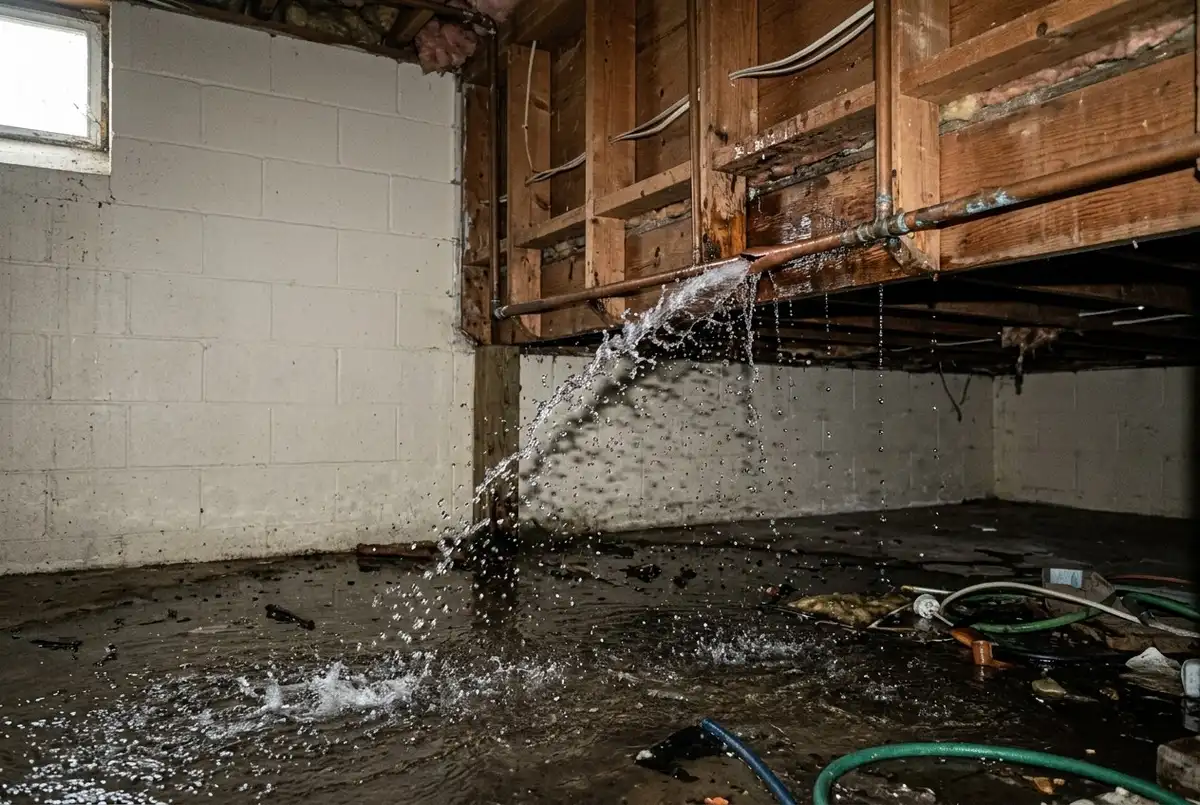
A split pipe can put out gallons a minute. How bad it gets usually comes down to whether somebody knew where the shutoff was. Read this now, on a dry day, so you know what to do when a pipe lets go.
By Joe Messina, Master Plumber
Or Request a Callback- License
- Master Plumber #BTC-0004081
- Hours
- 8am to 8pm every day, emergency line 24/7
- 4.8 stars, 264 reviews
What to do, in order
- Shut off the main. If getting to it means walking through water that has reached an outlet, a cord, an appliance or the electrical panel, stay out and call the water utility to shut the water off at the meter and the electric company to cut the power. In Springfield, City Utilities handles both. Otherwise, turn the valve clockwise until it stops. A lever takes a quarter turn, until it sits across the pipe. Don't force an old valve that won't budge. If the burst is under a sink or behind a toilet, the small valve right there may be enough.
- Open the lowest faucet in the house, a basement sink or an outdoor spigot, plus the highest one, like a tub upstairs. The lines drain and reduce the pressure at the leak.
- Turn off an electric water heater at the breaker, and leave it off until the water is back on and a hot faucet runs steady. With the house drained you can't be sure the tank is full, and elements that heat without water around them burn out. If you can't reach the panel from a dry floor, stay out and call the electric company. If the water got up to the bottom panel on the side of the heater, leave the breaker off until the heater has been checked.
- If you smell gas anywhere in the house, get out. Don't touch an appliance, a light switch or anything electrical on the way out. Call the gas company, or your propane supplier, once you're well away from the house. If you can't reach them, call 911.
- Leave a gas water heater off if any part of it has been under water. If you'd have to stand in water to reach it, leave it to the gas company. Otherwise push the gas knob in slightly, turn it to off by hand and don't relight it. If the knob won't turn, leave it alone and either turn the gas valve on the pipe feeding the heater so its handle sits across the pipe, or call the gas company to shut the gas off. Water heater makers say a flooded one has to be replaced. Leave a gas furnace or gas dryer that sat in the water off too, until it's been checked.
- Otherwise, set a gas water heater to pilot and leave it there until a hot faucet runs steady.
- Get things off the wet floor. Don't touch anything plugged in if it's wet or you're standing in water, and if the water has reached an outlet, a cord or an appliance, stay out until the power is off. Then move rugs, boxes, electronics, anything under or downhill from the leak. Keep clear of a ceiling that's sagging with water, and if water is coming through a ceiling light, leave that switch alone and turn the circuit off at the panel if you can reach it from a dry floor. Put towels down on hardwood right away.
- Take photos. Get the leak and the water damage before you clean anything up. Your insurance adjuster will want them. Keep the broken piece of pipe and anything ruined until the adjuster has seen it. Call your insurance company the same day, and keep receipts for anything you spend on cleanup. Run fans and a dehumidifier and get everything dried out within a day or two; past 48 hours, assume there's mold.
Call (417) 987-8740 as soon as the water is off. It's answered day or night, and if it's safe to snap a photo of the pipe itself, text it over so we know which fitting and pipe size to bring. Leave the main off until the pipe is fixed.
Where to find the shutoff in Ozarks houses
- Where the line enters the house. On a basement wall, or in a crawlspace just inside the foundation where the line comes through, usually on the side facing the street. Most houses have a valve here, and it's the one to use if you have it. In a house on a slab the line comes up inside, so check near the water heater, in the garage or a utility closet.
- Under a sink or behind a toilet. For a burst kitchen pipe under the sink, close both small valves where the lines come out of the wall or up through the cabinet floor, hot and cold. For the line behind a toilet, close the one valve at the wall or floor. Those small valves only stop a leak between the valve and the faucet or toilet. If the kitchen sink pipe burst on the wall side of the valve, or the valve won't turn, shut the main. If it's the drain under the kitchen sink that's leaking, the valves won't help; stop running the sink and the dishwasher until it's fixed.
- At the meter, near the street. Under a round or rectangular lid in the yard. That valve belongs to the water utility, and only the utility should turn it. If the house valve won't close, call the water utility at the number on your water bill to shut it off at the meter, then call (417) 987-8740.
- On a well: at the pressure tank. Turn off the breaker for the well pump first, since the pressure switch at the tank is live until it's off, then close the valve on the house side of the tank. The tank holds water under pressure, so do both.
Burst pipes in a hard freeze
A pipe can freeze and split overnight, and you won't see the water until it thaws. Before a hard freeze, unhook garden hoses, and if a spigot isn't the frost free kind, close the valve that feeds it from inside and leave the outside spigot open so it drains. During one, let vulnerable faucets drip, hot and cold both, and leave them cracked open even if the drip stops. Open the cabinet doors under the kitchen sink and any other sink on an outside wall, and don't shut heat off in rooms with plumbing. When you leave town, keep the heat set to 55 degrees or higher. A faucet that quits in a freeze is most likely a frozen line, so act before the thaw. Leave that faucet open, warm the area gently if you safely can, never with an open flame, and call it in. Stay close to the main while it thaws in case the pipe has split.
What happens when Messina's on the job
You get the price before the repair starts. If there's a problem with the work later, call and Joe will fix it.
Talk to Joe about it
Call and a master licensed plumber picks up the phone. Or text a photo and get a first read on what you're looking at.
Or Text a Photo of the Problem24/7 emergency plumbing and mechanical service
- For a leak or burst pipe, while you wait:
- 1Shut off the main water valve, usually where the line enters the house
- 2Open the lowest faucet to relieve the pressure
- 3Move what you can out from under the leak